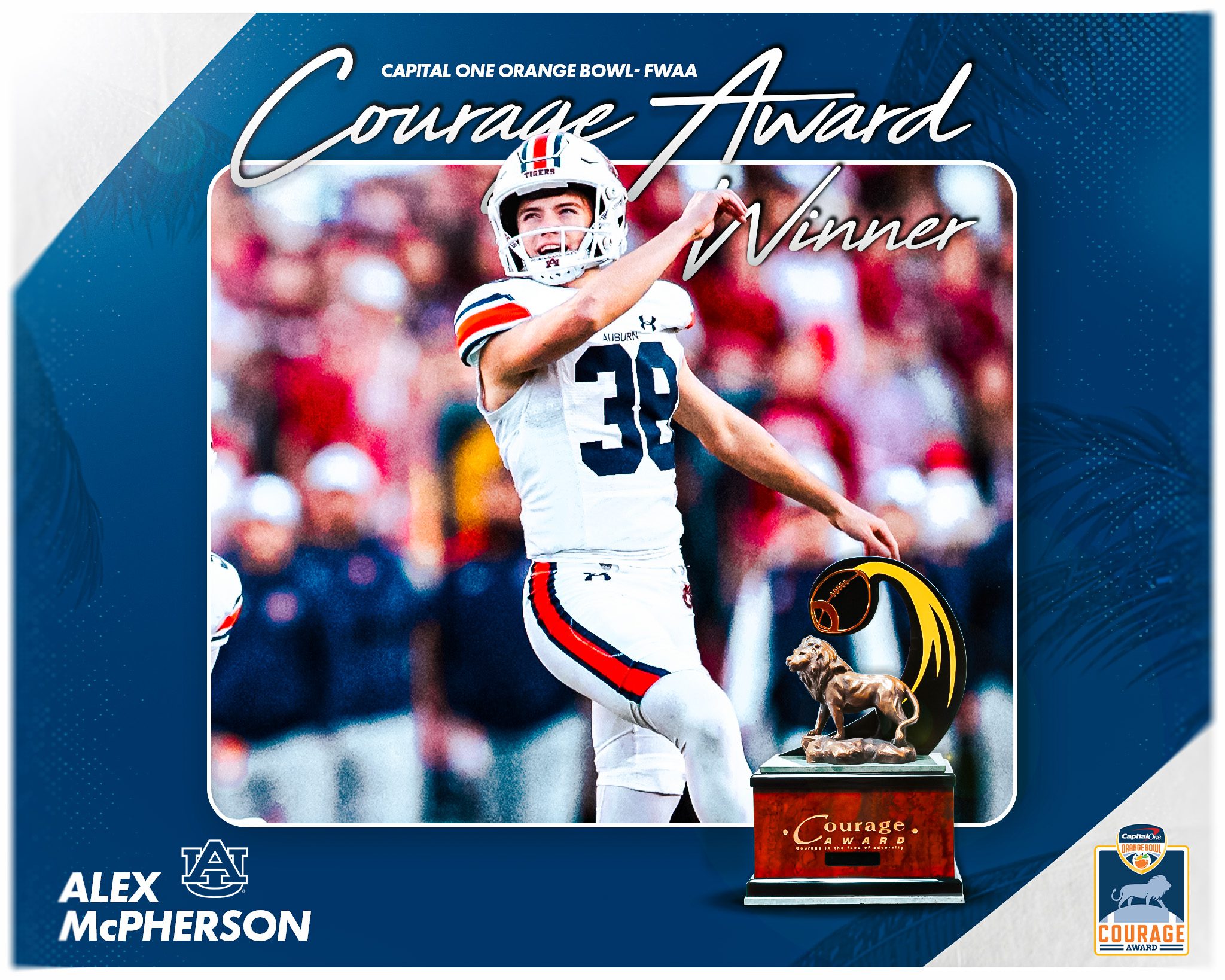
AUBURN’S ALEX MCPHERSON NAMED RECIPIENT OF CAPITAL ONE ORANGE BOWL – FWAA COURAGE AWARD
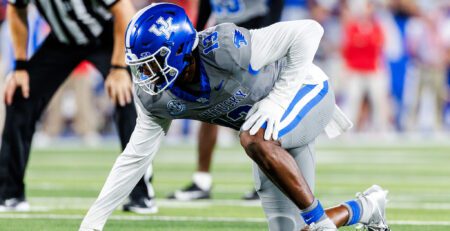
DALLAS (FWAA) — Auburn kicker Alex McPherson is the 24th annual recipient of the Capital One Orange Bowl-FWAA Courage Award. McPherson overcame Crohn’s disease to become one of the nation’s most proficient kickers, returning to form after a nearly two-year battle that featured multiple different diagnoses and treatment plans that eventually allowed him to build back up strength and play football again.
“It’s hard to put into words,” McPherson said of the honor. “It’s been an awesome year. From the beginning of the season, not even knowing if I’m going to be able to play the full season, to having the decent season I had, and to be able to come back and play with my guys on the team, this award is kind of the cherry on top. It’s awesome that I’m able to receive this, and it’s just an honor to be able to have it.”
“I’m excited just to see what the future holds now. It’s been a long road, but it was definitely worth it in the end,” McPherson added.
McPherson is the first player from the SEC to win the Courage Award.
McPherson went a perfect 13-for-13 on field goals during his redshirt freshman season in 2023, connecting on all 40 of his extra point attempts. Additionally, he was a Lou Groza Award semifinalist, and was named to the SEC All-Freshman team.
But McPherson had begun to feel sick that December with what he figured at the time was a stomach bug. He went to the bathroom more than a dozen times a day, dropping 20 pounds in the process. Four months later, in April of 2024, a colonoscopy revealed that McPherson had ulcerative colitis, an inflammatory bowel disease. He had to be hospitalized at the end of July after repeated vomiting, by which point he had lost 55 pounds and weighed 110 pounds.
McPherson had a six-hour surgery to remove his large intestine on Dec. 20, 2024. Doctors created a stoma, connected to an ostomy bag, outside of his body for waste to come out. McPherson, who kicks with his right leg, requested that the stoma be put on his left side.
He learned to kick with the stoma this past spring but suffered yet another setback, dropping 30 pounds in the process. In August, he was given a new diagnosis, Crohn’s disease, which led to a different treatment plan.
McPherson appeared in Auburn’s season opener Aug. 29 at Baylor, connecting on his only field goal attempt and going 5-for-5 on extra point tries in the Tigers’ win.
“Whenever I was going through spring ball and toward the end of spring ball, I was pretty much back to where I was before I got sick completely,” McPherson said. “That was when I knew, yeah, I think this is definitely a possibility of being able to come back and actually kick to the level I was, not just come back and do an alright job. I could meet my expectation of it. And then by the end of this season, I’ve gotten pretty much back to where I was, and that was exciting, too.”
A Fort Payne, Ala., native, McPherson came up clutch for Auburn in a 33-24 win at Arkansas on Oct. 25, connecting on all six field-goal attempts, including three in the fourth quarter, to complete an 11-point comeback and deliver the Tigers their lone SEC victory of the season.
McPherson hit 20 of 23 field goal attempts this season and connected on all 35 extra point tries. He finished the regular season No. 5 in the SEC and No. 26 nationally in field goal percentage (87 percent). His 20 made kicks rank fourth in the conference.
“Alex McPherson is a most worthy recipient of this year’s Courage Award,” former FWAA President Matt Fortuna said. “The perseverance that Alex showed to endure what seemed like a never-ending cycle of poor heath, and to adjust to the situation that he found himself in, is a characteristic that everyone in college football could learn from.
“The fact that he not only returned to the playing field but also proved to be a difference-maker for Auburn this season is a heck of a way to make a statement.”
A redshirt junior with one year of eligibility remaining, McPherson plans on making the most of his final season on The Plains. He says he is around 148 pounds now and, with a full offseason routine, hopes to get back up to 168 pounds, where he was before he got sick again in the spring.
“I was never sick growing up, I never had health issues, I never understood what it was like to not have good health, and (Crohn’s disease) makes me grateful for that,” McPherson said. “Every day when you have good health, it’s a great day. And so I’m really just enjoying those days whenever I do feel good.”
McPherson credits his wife, Hannah; his parents, Amber and LaDon; his brothers, Logan and Evan; and Auburn head athletic trainer Robbie Stewart for helping him get through his health challenges.
None of this would be possible, he says, without Auburn head athletic trainer, Robbie Stewart.
“He’s been a huge part of this, a huge part of everything that’s going on, because when they didn’t have the answers, he got the answers for me,” McPherson said. “He connected me with people that could help me. He never missed a doctor’s appointment. He was there the day of my surgery.
I could never pay him back enough for everything that he’s done for me and my family. Just getting me into doctors’ appointments, seeing the right people, just the amount of work that he’s done to try and get me back out on that field. I definitely wouldn’t have been back this year without him, and I’m just grateful for him, especially.”
The Courage Award was first presented by the Football Writers Association of America (FWAA) in 2002. A select group of writers from the FWAA vote on the winner each year. The requirements for nomination include displaying courage on or off the field, including overcoming an injury or physical handicap, preventing a disaster or living through hardship. McPherson will be included in festivities during Capital One Orange Bowl week and recognized during the game.
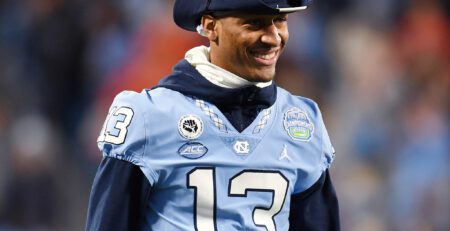
Previous winners of the Capital One Orange Bowl-FWAA Courage Award are North Carolina wide receiver Tylee Craft (2024), Virginia running back Mike Hollins (2023), Oregon tight end Cam McCormick (2022), the University of Utah football Team (2021), Arkansas State analyst Alex Charlton (2020), Arkansas State coach Blake Anderson (2019), SUNY Cortland linebacker Kyle Richard (2018), Wisconsin safety D’Cota Dixon (2017), Pitt running back James Conner (2016), Miami offensive lineman Hunter Knighton (2015), Duke offensive lineman Laken Tomlinson (2014), San Jose State defensive lineman Anthony Larceval (2013), Clemson wide receiver Daniel Rodriguez (2012), Michigan State offensive lineman Arthur Ray Jr. (2011), Rutgers defensive tackle Eric LeGrand (2010), the University of Connecticut football team (2009), Tulsa’s Wilson Holloway (2008), Navy’s Zerbin Singleton (2007), Clemson’s Ray Ray McElrathbey (2006), the Tulane football team (2005), Memphis’ Haracio Colen (2004), San Jose State’s Neil Parry (2003) and Toledo’s William Bratton (2002).